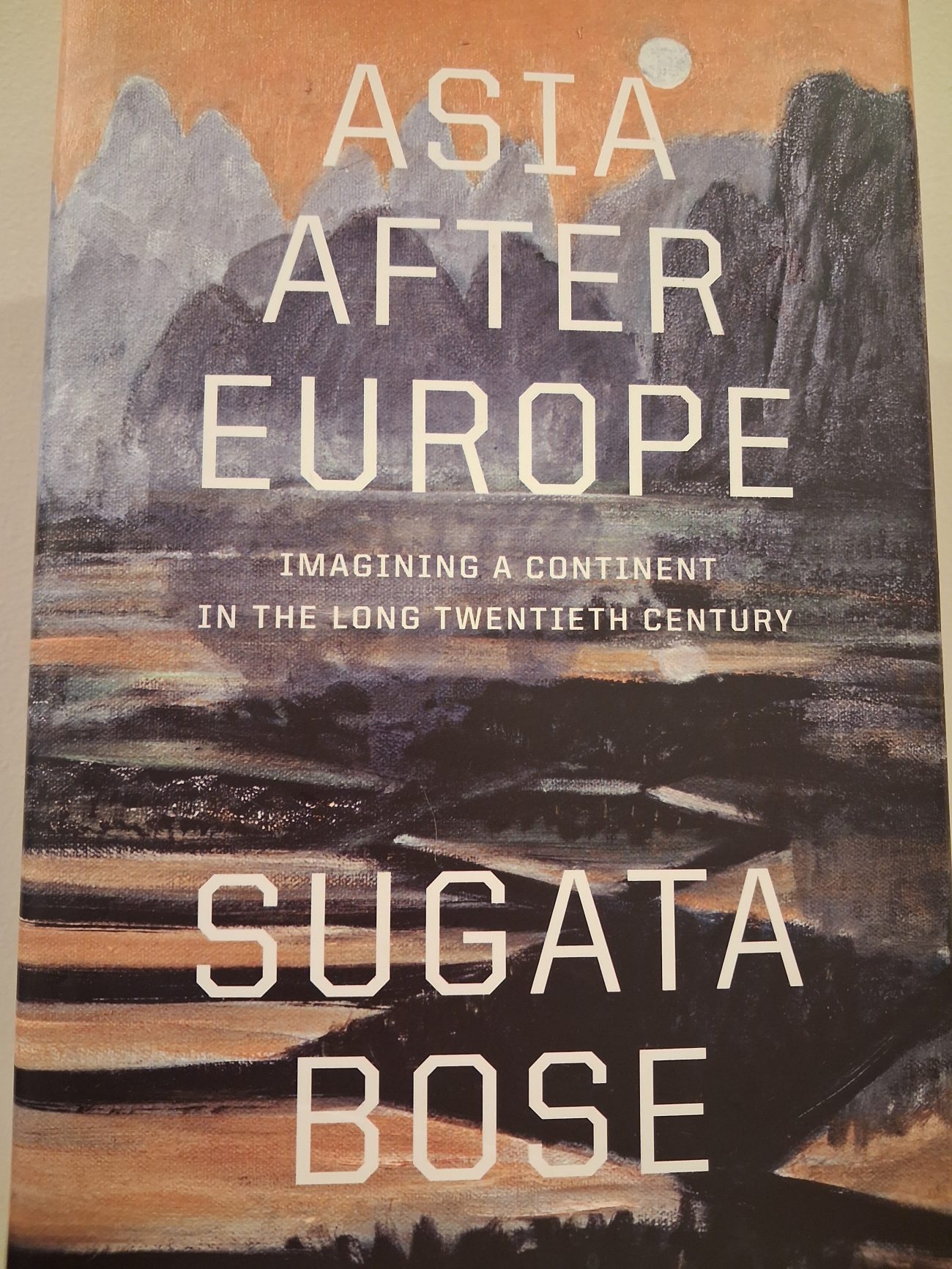
Sugata Bose, Asia after Europe (Harvard University Press, 2023)
What is Asia as a cultural space? Is it ever possible to envision this immensely diverse region as such? If so, what’s the relevance of imagining this vast continental and maritime space like that today? Sugata Bose’s recent book that’s soon to be his yet another canonical text engages with these questions and invites us to historical journeys taken by anti-colonial Indian intellectuals over a century. And this book can be read as an essential introduction to those who are interested in trans-Asian grassroots struggles, alongside Gayatri Spivak’s Other Asias, Kuan Hsing Chen’s Asia as Method and Tim Harper’s Underground Asia, as a text that enables us to recuperate the history of individual and communal interactions and connections and the language that was shared not only by established intellectuals but also many others, typically students and workers, across borders.
It is important to note that Bose’s meticulous articulation of Asia as a creative anti-imperial and decolonial ideal is neither for someone who wants to believe in a single exclusive ‘Asian Value’ as juxtaposed to the one in the West, extolled once by someone leaders and ideologues nor for those who want to know about the ‘rise’ of Asia as a new power center in contrast to the ‘decline’ of Europe. There are plenty of other titles for that sort of reader.
This is a history book, a genre that’s notorious for being filled with the details of names of people and places, it’s slow to move, and it requires patience to make sense of the whole picture. But that’s history through which our past is constructed, and it’s not constructed through a simple and single timeline. History compels us to get away from Facebook or the like to a quiet offline room, to get ready to learn about the complex processes, by which communities, ideas, and eras are made, involving numerous tales and views of individuals whose lives were dedicated to the uncertain future dream: a time that’s yet to be seen, called a decolonized world, will be unfolded in front of our eyes.
‘Asia’ here is not merely an expression of the massive geographical lands and seas that encapsulate thousands of cultures and peoples. Rather, it’s an evolving cultural concept created through interactions between cultures and peoples over a century between the mid-19th century, i.e., the highest time of the colonial rule in West, South and Southeast Asia, and the mid-20th century, the dawn of the postcolonial era. It’s interactions that are foregrounded in this book. One of the protagonists is Rabindranath Tagore, the first Asian laureate of the Nobel Literature Prize in 1913, along with Subhas Chandra Bose and Gandhi, and other Indian anti-colonial leaders. The book carefully traces and narrates their journeys to East and Southeast Asia, as well as the Middle East, and the friendship he received and nurtured, and the influence he left. The long list of his interlocutors includes Okakura Tenshin, known for his early exclamation – ‘Asia is one’ – in The Ideals of the East; and Liang Qichao, a renowned intellectual and political activist, among numerous others across the continent and seas.
Their ideals of anti- or decolonial future are not identical, often discordant in reality, and their solidarities with one another are also not pre-coordinated. Every single individual who appears in the book is working on their own political agenda, yet while similarly pursuing and struggling to carve out and articulate the time they lived. This leads to the land point I quickly emphasize – colorful cosmopolitanism, which penetrates throughout this book. It’s a concept not to encompass, but that guides us in understanding how Asia, as a cultural space, was imagined by such multitudinous thinkers and activists. In other words, it’s a concept that helps us see the hinges that connect or glue between layers of discrete articulations of anti-colonial ideals that overlap. What this coinage also indicates is, as Bose reminds us, cosmopolitanism is not always conceived based on the Kantian model – detached from the particulars to be value neutral and abstract. Conversely, Bose cogently argues that cosmopolitanism can be something that is rooted in a specific context, culture, and language that’s often framed as a ‘local’ or ‘particular’ as opposed to the ‘universal’. Insofar as it is, cosmopolitanism can be reconceptualized as an amalgam that comprises various concentric circles of thoughts and practices.
Asia after Europe is indeed a history book written so elegantly by Sugata Bose, the champion of modern South Asian History, along with his contemporaries, such as Sekhar Bandyopadhyay, with exceptional oratorical skills. And as noted passingly, imagining decolonial Asia does not have to be built upon the Western canons. There are thousands of deep currents that take us to speak about ‘Asia after Europe’. A profoundly critical read at this great political and historical juncture.
Shin Takahashi
Naarn/Melbourne
