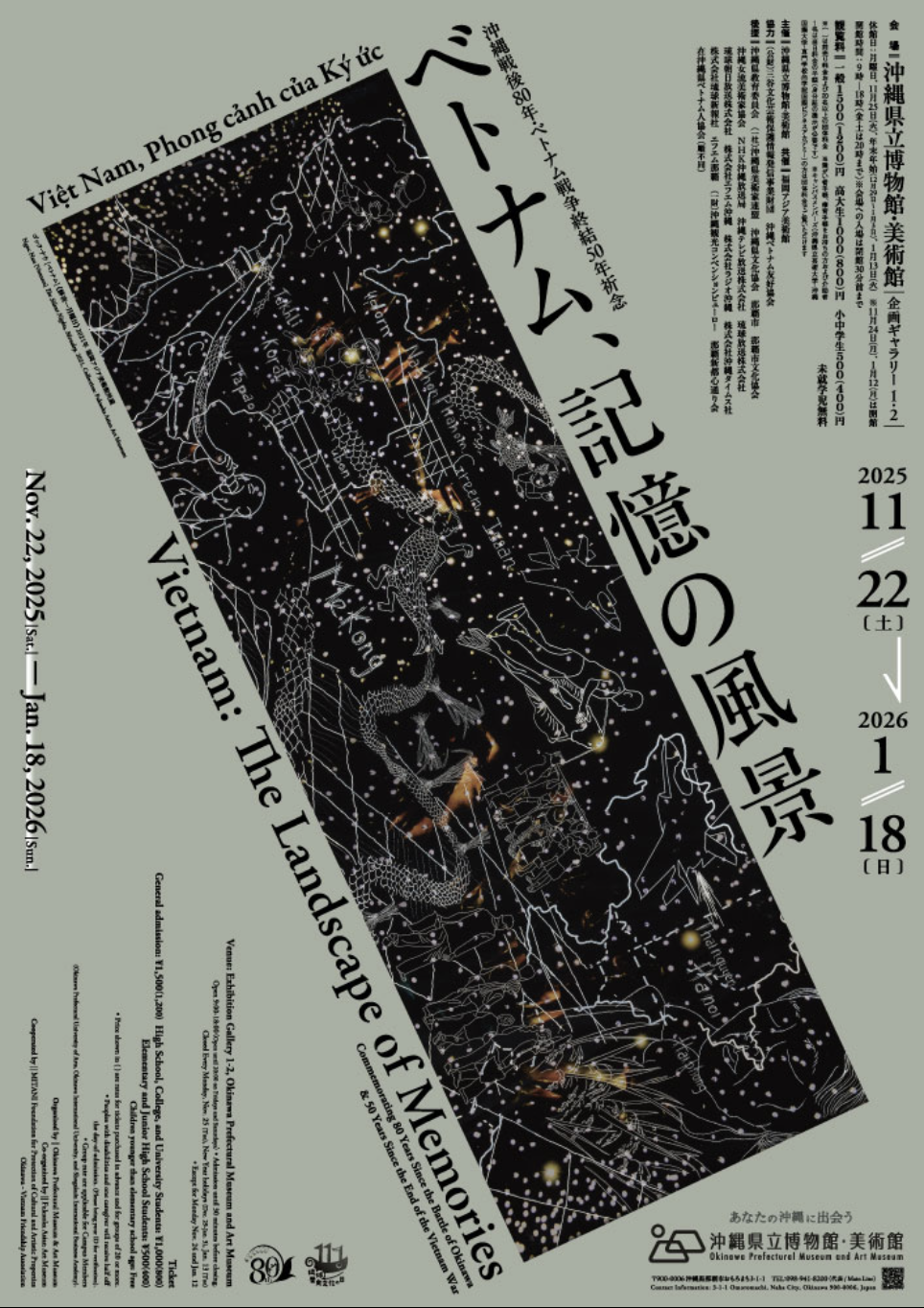
Venue & Period:
Fukuoka Asian Art Museum: September 13 – November 9, 2025
Okinawa Prefectural Art Museum: November 22, 2025 – January 18, 2026
Another war in the West Asia has begun. We have received the news that the Trump administration has ordered U.S. Marines rapid response force stationed in Okinawa with 2,500 soldiers to the Middle East. Since the end of the Battle of Okinawa in 1945, because of the U.S. Military bases, Okinawa have been linked to the battlefields in Korea, Vietnam, Iraq, Afghanistan, and now, Iran. After the end of the battle in Okinawa, we know that the United States has never won a war, except for the small-scale war in Kuwait. However, the United States does not stop its desire to go to the quagmire of war.
Every time a war breaks out, people here are pushed down into a difficult psychological state. Of course, Okinawa itself might not the perpetrator directly, but people are tormented by doubts, anxieties, and anger. Considering Okinawa’s past war experience, it is wrong to be complicit with the perpetrator. Refusing to be killed, to kill, and to cooperate with the perpetrators is the way that many people in Okinawa imagine peace.
Such an image of peace was not created immediately after the war in 1945. Rather, it was created through two American wars in Asia: Korea and Vietnam. In particular, the Vietnam War had a great impact on Okinawa’s anti-war and peace consciousness.
Even today, in Okinawa, when people say “Betonamu”, or “Vietnam”, it always sounds special. Though many people haven’t been there, still, it sounds so familiar.
For the elders, it is all because here’s been the American bases have been here, where the B52 strategic bombers took off to the North and South, and the infantry and marine corps were trained and sent to the Mekong Delta in the South. Okinawan workers, especially base workers refused to cooperate with the war against people in Vietnam and went on strike in the late 1960s and early 1970s.
However, it might not have grown more than reminiscence. Vietnam was far away. Many people were unable to go to Vietnam and directly meet with the Vietnamese people. Though Japan established diplomatic relations with North Vietnam in 1973 after the Paris Agreement and the withdrawal of U.S. troops, actual exchanges and communications remained stagnant. The United States imposed economic sanctions on Vietnam for 20 years even after Vietnam’s reunification. The Vietnam War greatly damaged American hegemony, but the United States began and continued interventions in the Middle East. The people of Okinawa kept witnessing the U.S. troops heading to the battlefield. In August 2004, a Marine Corps helicopter traveling back and forth between Fallujah in Iraq and Okinawa crashed on the campus of Okinawa International University. The direct action against the new American base construction in Henoko such as the sit-in on the sea struggle began during the Iraq War. It has continued for more than 20 years since then.
Even after the end of the Vietnam War, Vietnam has always been remembered in Okinawa whenever the Americans start the war. The younger generation, however, may feel closer to Vietnam in a different way, as they meet many young Vietnamese migrant colleagues at their workplaces, such as convenience stores, tourist hotels and restaurants in Okinawa. They may only vaguely understand the historical connections between Vietnam and Okinawa.
In any case, the aura of the Vietnam War in Okinawa has tended to be mostly through the images of wounded American bases and soldiers, rather than through realities and imaginations of the Vietnamese themselves. We need something to fill the time and gap between the people of Okinawa and that of Vietnam. Just as the Battle of Okinawa needed to be told from the perspective of the Okinawan people, not from the military perspective of the Japanese and American forces, it is important for us in Okinawa to imagine the war memory from the narrative and perspective of the Vietnamese people. For example, there is little awareness in Okinawa that in Vietnam there is no word the “Vietnam War.” Instead, people call it the “War of Resistance against the United States.”
Last year, 2025, marked the 80th commemoration of the end of the Battle of Okinawa, and it was also the 50th anniversary of the end of the Vietnam War. The Okinawa Prefectural Museum of Art decided to hold a special commemorative exhibition of Vietnamese contemporary art, succeeding the exhibition at the Fukuoka Asian Art Museum.
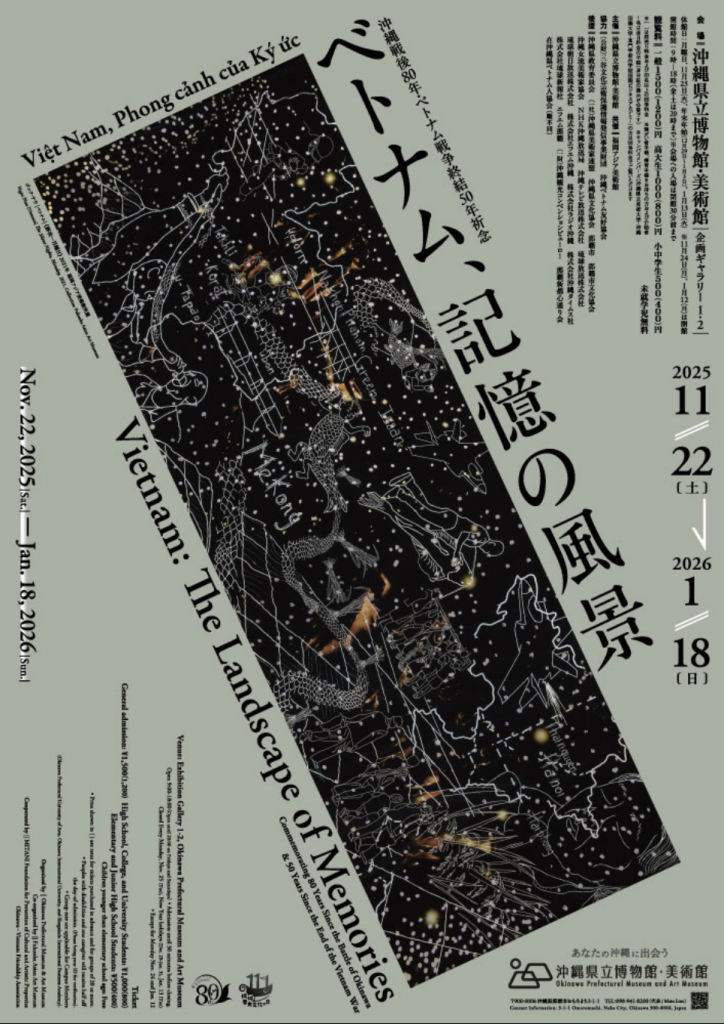
Now, after the decades after the end of the war, how can we re-encounter Vietnam in Okinawa? How can we perceive the bridge of art between two places?
In this exhibition, we travel from the French colonial era to the present time. The contemporary history of Vietnam has undergone intense, and often harsh, changes such as French colonial rule, Asian socialism, the cold war and hot war, economic development, and integration into Southeast Asian nations, etc. Despite these turbulent changes, local lacquer painting and silk painting have been constantly the deep-rooted in the backbone of art in Vietnam.
In 1925, École des Beaux-Arts de l’Indochine was established by France. Although the framework and techniques of Western art influenced Vietnamese artists, they used lacquer painting and silk painting to portray the image of the “Vietnamese-ness”. Even confronting the devastating war against the Americans, Vietnamese artists used these techniques rooted in local communities, powerfully depicting the people and community.
The exhibition featured silk paintings by Nguyen Phan Chang [Nguyễn Phan Chánh] (1892–1984)
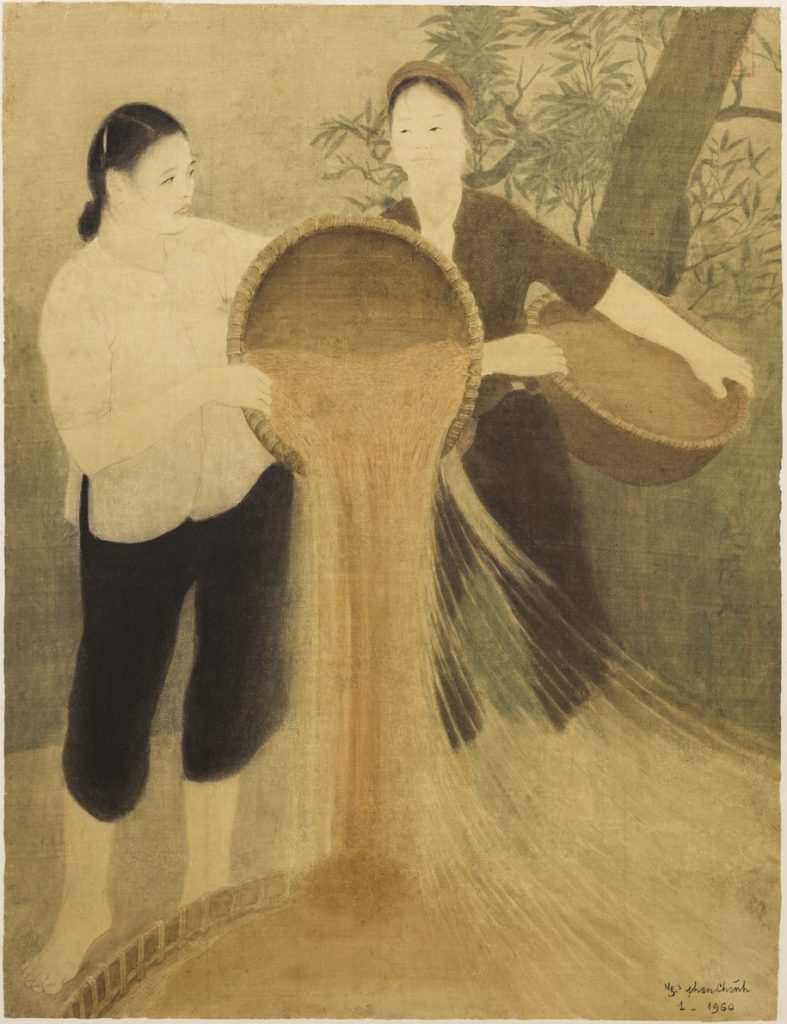
Many of these depict rural landscapes and women. The technique of overlaying watercolors on silk brings out the beauty of rural villages and farming works in pale colors. However, the rural villages suffered from destruction and famine under the French colonial rule, Japanese military rule, war against France, and war against the United States. The artist knew how deeply people suffered, and we recognize that it is precisely because of such a cognition that the artist attempted to express the farmers’ visions as beautifully as possible.
Lacquer painting, like wood-cut print, makes us imagine human life such as labor, work, and activity. It is not only a matter of paint-brushing but also engraving wood. Dang Bay’s “She Can Do Anything” (1971) is a small-size piece, but just like Nguyen’s silk paintings, it transcribes the vision of rural people. Some may say that this was the propaganda for the Liberation Front’s war, however there is no North Vietnamese flag shown. Instead, in the courtyard, loofahs are waiting for harvest, a calf is snugging with its mother cow, and chickens are moving around.

Contemporary Vietnamese artists also use lacquer and silk paintings as their foundation for art. The exhibition in Fukuoka and Okinawa featured a video installation “Mute Grain” by Thao Nguyen Phan [Phan Thảo Nguyên]. She has been one of the most notable Asian artists in the first quarter of the 21st century. Based in Ho Chi Minh City, Phan is known not only for her video installations, but also for her numerous works using traditional lacquer and silk painting techniques. The video installation “Mute Grain” depicts the memory of rural famine that occurred during the Japanese military rule. However, this is not a simple historical documentary, but a “emakimono 絵巻物 (scroll painting in Japanese)” portraying the reincarnation of memories, interweaving myths and rituals with the history of famine.
In a different way from Phan, there are artists who reflect on what it means to live with history. Nguyen Minh Tanh [Nguyễn Minh Thành] created the works of watercolor on rice paper, “Two Pillers,” which seems to show the vulnerability of being in rapid economic growth and urbanization, following the end of the war and unification.
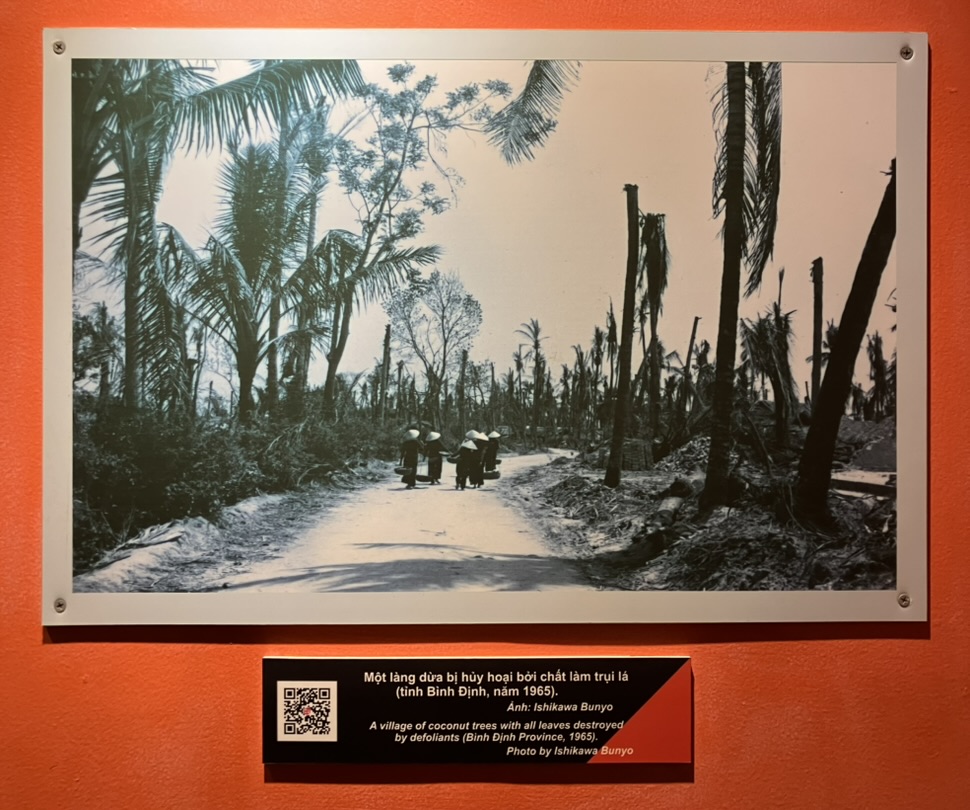
The exhibition in Okinawa also featured works of post-war Okinawan artists, such as the photographer, Ishikawa Bun’yo 石川文洋.
Ishikawa, born in Okinawa in 1938, stayed in Vietnam and reported the war from 1965 to 1968 as a freelance photographer. After the war, Ishikawa continued to cover Vietnam intermittently, and since 1998, 250 photographs of Ishikawa have been on permanent display at the War Remnants Museum in Ho Chi Minh City.
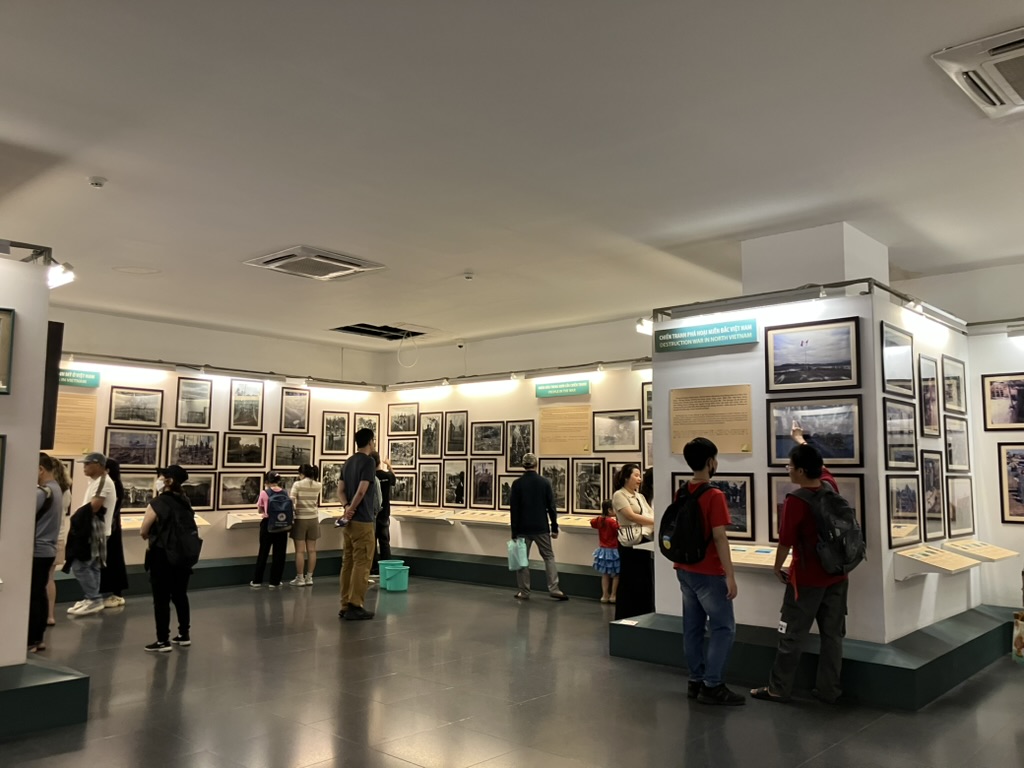
Ishikawa’s camera was always focusing on people in rural communities. He said that during his days in Vietnam, he imagined Okinawan people overlapping Vietnamese people on the battlefield in Vietnam. But even for an experienced journalist like Ishikawa, the landscape destroyed by Agent Orange was beyond his imagination.
This exhibition gave us the opportunity to reconsider the Okinawa’s experiences during the war in Vietnam and beyond. What kind of dreams were they fighting for? What was the dream of liberation from colonialism? In Vietnam today, the most rapidly developing economy in Southeast Asia, what are the memories of the dead haunting around the people and places? Are there memories and dreams like those of Okinawa? It is to perceive that time and history will never be linear. We must search for the unseen landscapes and hidden layers of time.
Chiyo Wakabayashi
Naha, Okinawa
