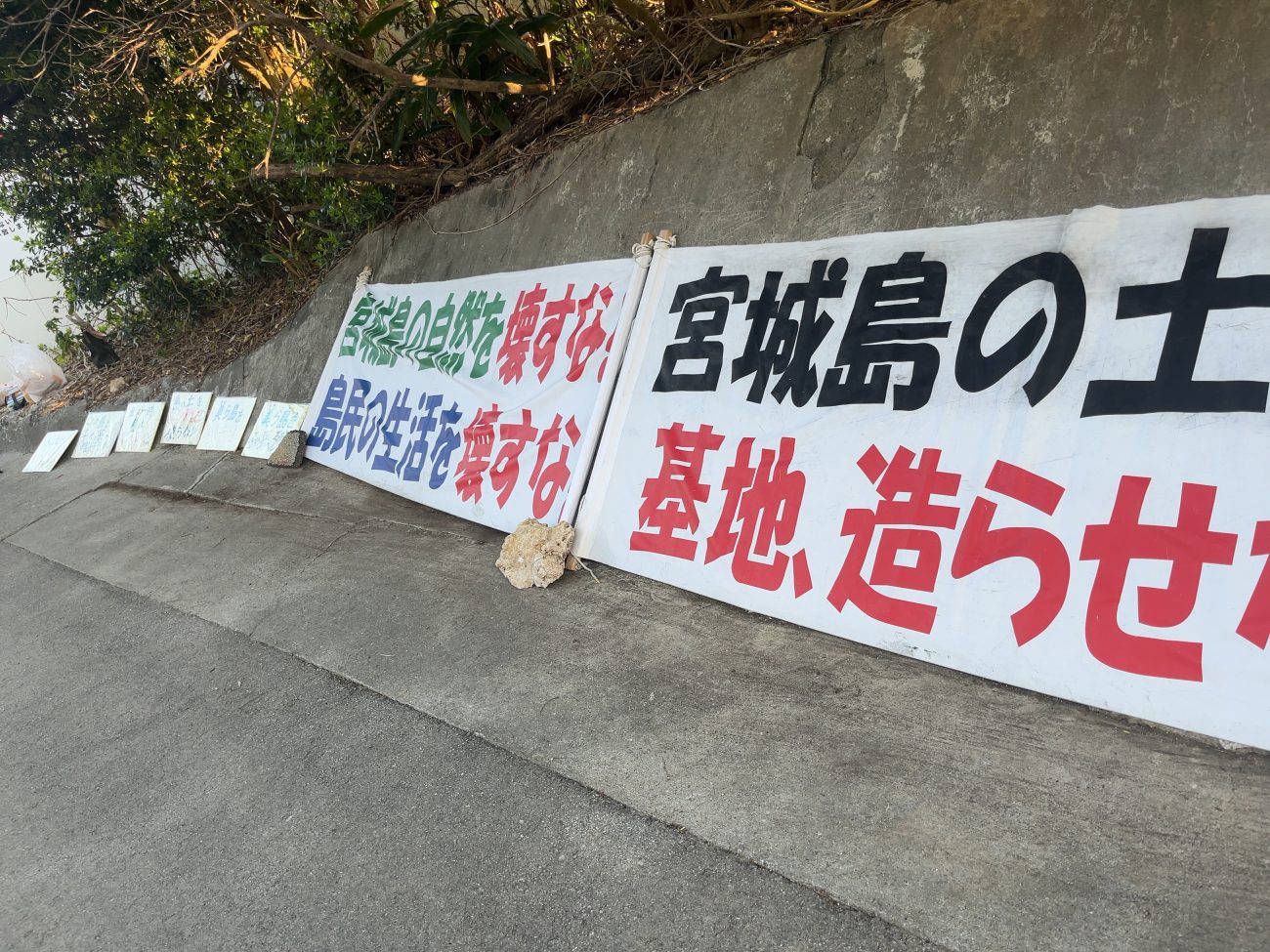
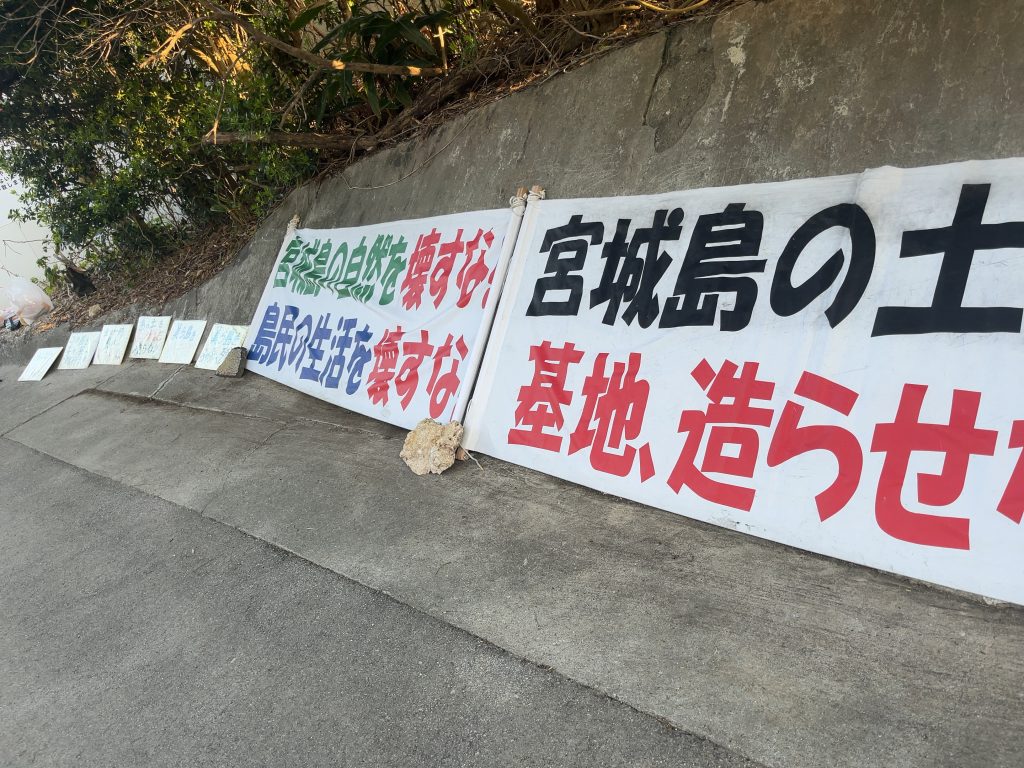
It was a hot and humid summer morning in late August. I was standing with three people in their seventies and eighties, and we started walking from the edge of the Okimiya Mining Company gate. We held a banner declaring, “Do not destroy the ecology of Miyagi Island! Do not destroy the lives of the islanders!” I was the third and rather inconspicuous person from the front of the line, led by activists almost twice my age. We had assembled at the protest site with the intention of delaying the construction of a new U.S. military base at Henoko and Oura Bay.
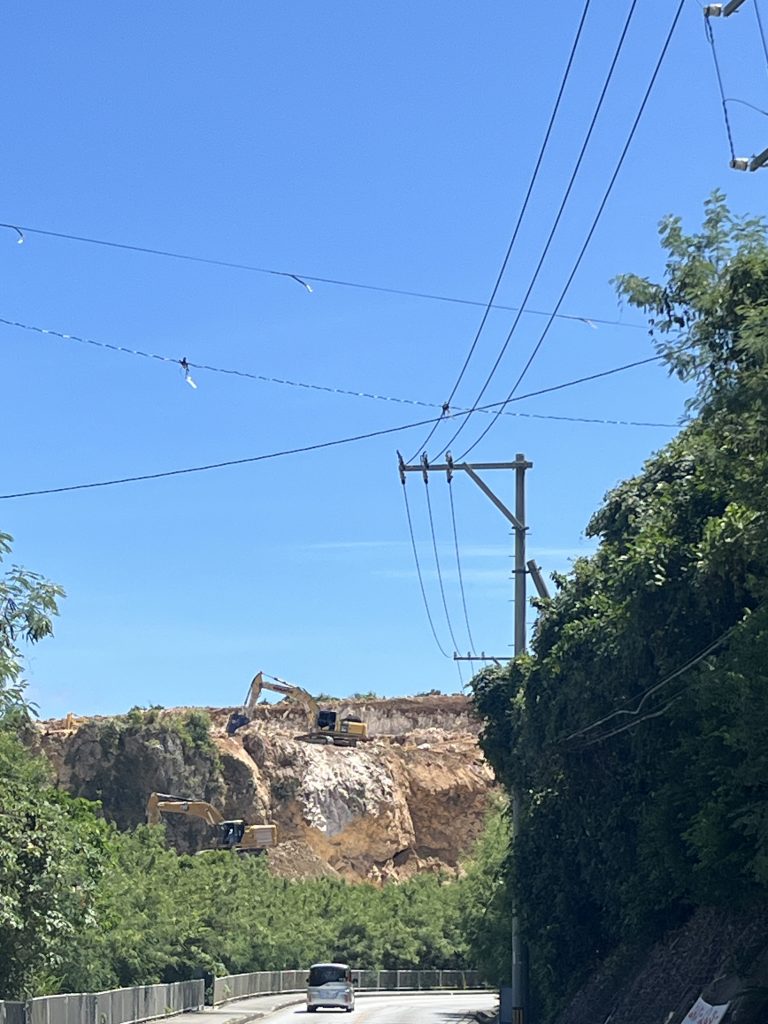
Okimiya Mining Company is located near the northern tip of Miyagi Island, on the eastern coast of Okinawa. The mining company excavates earth and sand, selling them to the Okinawa Defense Agency for use in the Henoko Bay landfill. In addition, landowners can sell leveled land to build resort hotels. Soil that contains the skeletal remains of those who had died in the Battle of Okinawa is planned to be used as construction material for the Defense Agency. The land has been commodified in different parts of Okinawa, and this is also underway in Miyagi Island. Even when it rains, the mining continues nonstop, except on weekends.
We started our “centipede march” (i.e., getting in line and barely moving) from one side of the edge of the gate to the other, while dozens of dump trucks carrying earth and sand stood waiting. It took 40 minutes to reach the other side of the gate, which was only six or seven meters away. This was a direct act of civil disobedience, and its primary purpose was to slow down the construction.
Knowledge Produced at the Grassroots of the Struggle
This action is supported by the speeches of the protesters, who have repeatedly demanded the local municipal government to disclose plans concerning excavation and proven its illegitimacy. In the face of the riot police, which are backed up by state power and whose actions are unpredictable, the speeches remind us that justice is on our side.
Teruya Katsunori held the microphone that day. When he was a student at Maehara High School, in the midst of a school-wide protest against a U.S. soldier’s attempted rape of a severely injured female student, some students also raised their voices against the revision of the U.S.-Japan Mutual Security Agreement, barricading themselves in the classroom with chairs and desks, and were expelled because of this militant action. Teruya joined the struggle to demand the revocation of the expulsion and decided to drop out of high school, after a teacher asked him to sign a pledge to “not to engage in political activity” which he refused.
Teruya then joined the Okinawa Middle District Anti-War Youth Committee (Chūbu-chiku Hansen Seinen I’inkai) and protested the transportation of U.S. biological and chemical weapons in the summer of 1971. Afterward, he moved to Tokyo and organized the Okinawa Workers’ Association (Okinawa Rōdōsha no Kai) and the Yūna Association (Yūna no Kai) while working at a publisher. While living in Tokyo, he discovered Okinawan workers of his generation who could not afford to engage in political struggle, including an Okinawan woman in her twenties who had starved to death, and a young Okinawan man who had resisted his boss’s bullying with arson and committed suicide while in custody. Displaced from their land and sea under the guise of “development,” these Okinawan youths who became “cheap labor” in mainland Japan, facing alienation and exploitation, had to struggle just to survive. Teruya and his fellow Okinawan workers got together once a week, ate dinner, and shared their feelings of alienation and nostalgia for their homeland. They sometimes held picnics and also organized Eisā (a dance that is performed by young people in each community in Okinawa during the summer to honor their ancestral spirits) in Tsurumi, Yokohama. They also engaged in solidarity actions with the Kin Bay Struggle that opposed oil tank construction, and protested rapid infrastructure development for the 1975 Ocean Expo in Okinawa.
Teruya left Tokyo and returned to Okinawa in 1978, making Gushikawa the base of his action, and threw himself into the Kin Bay Struggle. After the mid-2010s, he has been putting his body on the line to “directly stop” the military base construction and Japan Self-Defense Forces’ missile deployment, which were imposed without popular consent. While running a printing company, he has written about his early morning protest actions in Henoko and Takae since 2015. During the period, when the earth and sand were about to be dumped into Henoko Bay, he organized with his comrade a “Six-Day Mobilization of 500 People at the Henoko Gate”. Teruya states that the very comrades who had acted together in this mobilization are the ones who have opened up important moments in the movement at the grassroots.
Diverse People Gathered at the Grassroots of the Struggle
The origins and backgrounds of the participants in the direct action are diverse. One of the male participants I met was born in Saipan and moved to Miyagi Island with his family. A woman who walked at the end of the centipede line was part of the Miyagi Island Protection Society (Miyagi-jima Tochi o Mamoru Kai), which was organized to protest the construction of Gulf oil tanks. Another male participant who showed up in the afternoon was one of the canoeing protesters at Henoko; while continuing to be part of the struggle, he and his fellow canoeing activists make monthly visits to Ahagon Shōkō’s farmland on Ie Island. He said the following:
There are many people who care about Okinawa, but who among them actually come to Okinawa? And among those who come, the few who come here regularly and even move here to be part of the struggle are miraculous persons in a million.
At the grassroots, I also met another “miraculous”. His name is Kida Akio. He was shocked by Taira Yoshiaki’s words: “There is ‘Okinawa Problem’, but there is no Okinawa Struggle in mainland Japan”, and decided to come to Okinawa. After protesting the 1975 Ocean Expo, from the mid-1980s onward, he took part in the establishment of a communal nursery school and a used bookstore in Koza. Now, he is part of the Miyagi Island centipede march. His sister occasionally sends food to him, which he shares with his fellow protesters. He has lived in Okinawa, keeping in mind the remarks of Asato Seishin: “What is noble is Okinawa remaining Okinawa, and this is what will bring forth light”.
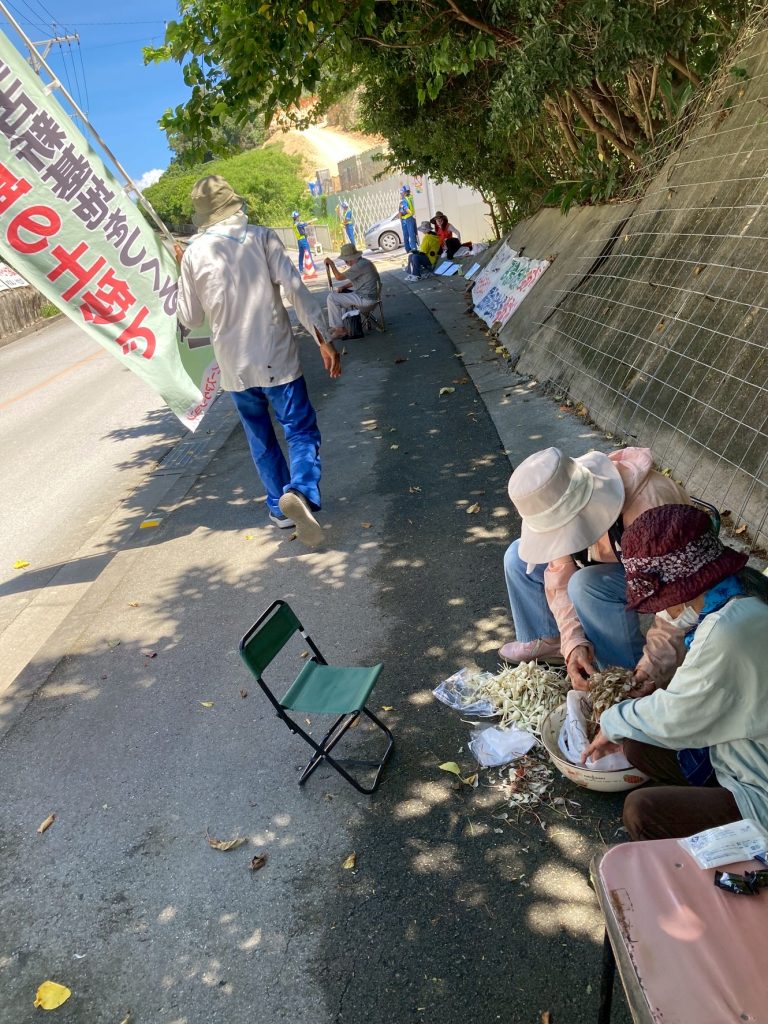
The grassroots movement brings together individuals who have visited multiple places at different times. There is no logic of “positionality” at work here judging who is and who is not allowed to join the struggle. They have a common understanding that it is above all “human” life, which the state is trying to destroy. This is why people from all over the world who are angered by the violation of human rights and dignity as their own personal matter work together to ensure that Okinawa remains Okinawa – this is precisely what is felt and transmitted as the reality at the “grassroots”.
Reverend Taira Osamu and Taira Etsumi were exemplary in practicing this grassroots spirit when they had supported all defendants prosecuted under the Special Criminal Law in the late 1970s trials of those who had trespassed on a U.S. Marines live-fire training area during the Kisenbaru Struggle. Taking place right on the heels of Okinawa’s reversion to Japan, it was the first court case in which the Japanese police enforced the Special Criminal Law against the popular movement in Okinawa. The Tairas, along with their son, left Sashiki Church at five in the morning and headed for a hamlet of Kisenbaru. The direct action was organized by the Okinawa Council against Atomic and Hydrogen Bombs (Okinawa Gensuikyō), and Reverend Taira offered a prayer: “Please guide and bless our walk to cherish human life”.
Four workers and three students were arrested during the Kisenbaru Struggle. The Tairas and their fellow activists established the Citizens’ Society to Support the Defendants of the Special Criminal Law (Keitokuhō Hikoku o Sasaeru Shimin no Kai). In the Society’s document entitled The Fire of Kisenbaru (Kisenbaru no Hi, published in 1978), Taira Osamu wrote the following:
There are seven “human beings”. They used their own bodies as shields at the military live-fire range. They risked their lives and appealed to “stop the killing” and “stop the preparation to kill each other”. Nothing can surpass the truth of what they were saying. However, they were arrested and judged under the sneaky rule of the Special Criminal Law.
If this trial is the beginning of a dark age whereby meeting righteous people requires us to visit them in jail, these seven individuals must win the trial against this current. It is not the rule of the Special Criminal Law, but they who must be led to victory.
The Tairas and the other members of the Citizens’ Society to Support the Defendants of the Special Criminal Law continued to unconditionally support the workers and students, whom the powers that be and sometimes the labor union tried to divide.
Drag Your Feet on Purpose
At the grassroots of Miyagi struggle, all individuals walk in the “centipede march”, stepping in line with the other participants. There is a unique rhythm and speed in the way they walk at a snail’s pace, as seen at Awa Pier and Shiokawa Port in Motobu Town, where people protest the transportation of earth and sand to the ocean landfill in Henoko. A centipede march only works if one walks in line and keeps pace with the others.
In a sense, this “centipede” seems also a metamorphosis of the “snake” or “zigzag” demonstrations during the 1960 Anpo struggle in Japan, which Sakai Takashi has vividly analyzed in his Snake People (2025). The zigzag tactic was also used in Okinawa in the students’ movement against the U.S. occupation, in the base workers’ 48-hour general strike, and in the students’ protest against the U.S. military live-fire training during the Kisenbaru Struggle. The recent snail’s-pace and centipede tactics are a practice of resistance developed in the contemporary context, in which policing has been strengthened and occupying the streets has become more difficult.
I do not know whether any of these protesters have devoted themselves to zigzag rallies in the past; however, the grassroots of the struggle against the Henoko landfill consisted mostly of women and featured creative tactics and negotiations in opposition to power. They manage on their own the pace and speed of the walk. In June 2024, unfortunately, there was an incident in which one woman was severely injured and one security guard was killed. Some suppose that this tragedy occurred because the Okinawa Defense Agency demanded the security guards to guide the dump trucks at an unreasonable speed while simultaneously urging protesters to cross the street quickly so as not to prevent the delay of transport of landfill material.
You cannot be a centipede by yourself. You must line up and walk in step with your fellow participants. You have to consider the pace of the people in front and behind you, and by doing so, you can disrupt the coercive, disciplinary sense of time imposed by the state. The rhythm of the centipede march is antithetical to a society that prioritizes speed and efficiency. The centipede march is not about a specific individual or group; it is the power of the people who match their pace with others, walking slowly with numerous legs.
Let’s walk as the legs of a centipede!
Kozue Uehara
Tokyo