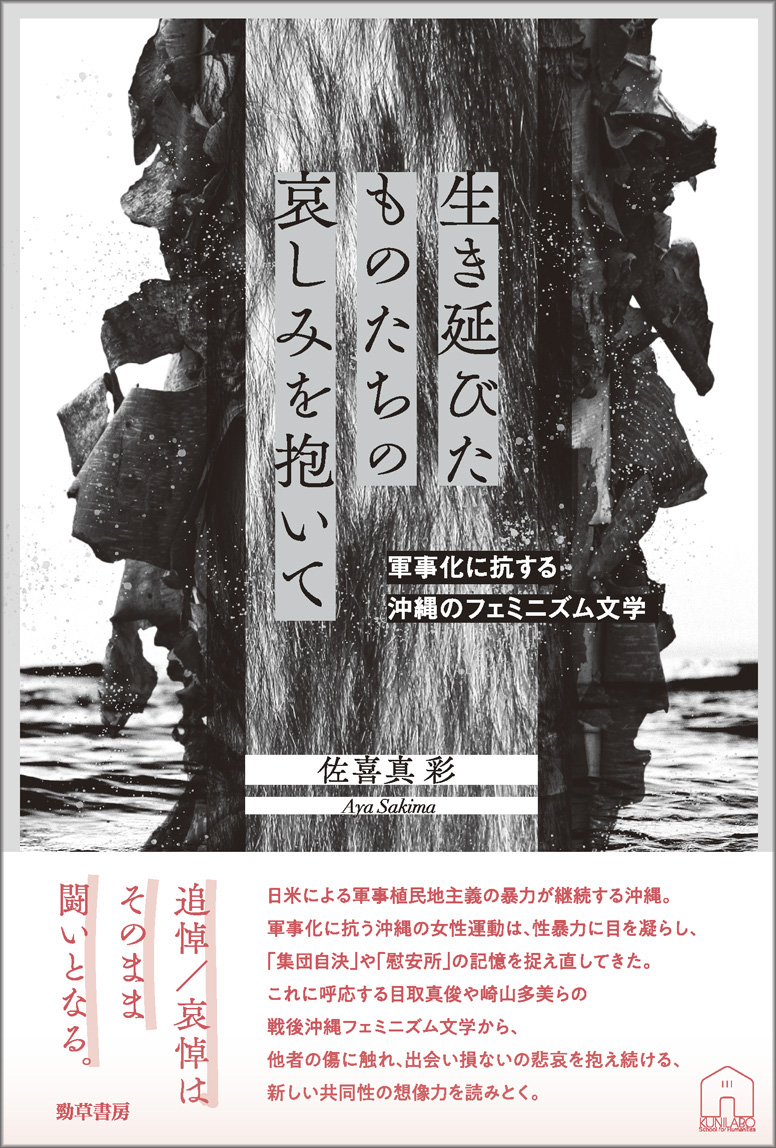
(佐喜真彩『生き延びたものたちの哀しみを抱いて――軍事化に抗する沖縄のフェミニズム文学』勁草書房、2025年)
“Survivors’ guilt” names a particular kind of pain. To survive a catastrophe does not simply mean feeling relief at having escaped death or affirming one’s own life. In testimonies by survivors of the Battle of Okinawa, what we often hear instead is the grief of surviving when others could not—the grief of being unable to save those dying before one’s eyes. Survival cannot easily be separated from the deaths of others. It may become a source of guilt, and that pain can continue long afterward, as if one were haunted by the dead. We may call such wounds trauma or melancholia, and scholars of the Battle of Okinawa have shown how they can be passed down across generations. Yet this grief does not appear only as illness.
In Okinawa, I have also witnessed grief becoming an invisible thread that binds people together and moves them to resist a politics that produces death. People gather at the gates of Henoko, where a new U.S. military base is being built. Others continue to speak about and pass on memories of the Battle of Okinawa. One person, through the quiet and painstaking work of recovering the remains of the war dead, carries out what he describes as “active memorialization” (kōdōteki irei), always alone. Since the war, Okinawa has also produced a wide range of literary and philosophical works, as well as forms of expression beyond the written text—photography, film and video, embodied performance, protest festivals, and commemorative gatherings—that respond to and amplify these practices of remembrance and resistance. Across these sites, grief resonates and becomes movement. It becomes a refusal of U.S.–Japan military colonialism, which once again treats Okinawa as a “disposable stone”: Japan did so during the Battle of Okinawa by turning the islands into a ground battlefield for the defense of the mainland, and U.S.–Japan military colonialism does so today by pushing forward the region’s militarization as an outpost against the rest of Asia.
This book explores how grief in Okinawa has become not only a wound, but also a force for memory, resistance, and feminist solidarity against militarization. It examines how Okinawan communities have re-encountered the memories of (wartime) sexual violence—memories that have long been marginalized, othered, or not fully recognized as “loss” even within Okinawa itself. Focusing particularly on feminist movements since the 1980s and on the fiction of Medoruma Shun and Sakiyama Tami since the 1990s, I trace how literature and cultural practices have opened a space in which the dead can be held in mind and remembered through the body. Victims of wartime sexual violence have often been forgotten within the dominant narratives of Okinawan history. Even within Okinawa, lines were drawn between lives seen as worthy of protection and lives that were not. It seemed to me that if Okinawa is to open circuits of solidarity with other regions, it must first confront this unequal distribution of life within Okinawa itself. Since the 1980s, feminist movements in Okinawa have done precisely this. As they question the boundaries that make solidarity between Okinawa and other parts of Asia difficult, they have also turned toward a re-encounter with the “other” within Okinawa itself.
I focus on survivors’ grief because, at its core, it is an awareness that one’s own life rests on the sacrifice of others. It is an affect that resists forms of life sustained through the abandonment of others. This grief should not be closed off as a private psychological problem to be pathologized and diagnosed. Rather, I understand it as a circuit through which one cannot but recall others: an affective circuit in which the living come to carry the deaths of others within their own lives.
Okinawan feminist movements and literature do not allow mourning for victims of sexual violence, whether in wartime or in the ongoing violence of the present, to end as mere commemoration. Instead, they have opened up a politics of mourning in which bearing loss and continuing to remember become forms of struggle. In a place where militarization based on joint U.S.–Japan military colonialism continues to shape everyday life, dwelling with survivors’ grief can become a foothold for reweaving forms of collectivity beyond blood ties, locality, and nationalist belonging. It can also offer a way to imagine solidarity across unequal histories of loss, and the possibility of surviving together.
